

In 2025, technology and customer expectations have reshaped the limousine industry. Gone are the days when a simple dispatch board was enough – today’s limo services must offer a seamless, Uber-like experience to stay competitive.
This comprehensive Limo software guide explores why modern limo businesses need feature-rich software, compares the top five platforms available, and provides a checklist of crucial questions to ask when choosing the right solution for your operation.

Technology has raised the bar for customer service in ground transportation. Rideshare apps like Uber and Lyft have trained customers to expect real-time communication, transparency, and convenience. As a result, features that once seemed luxurious are now baseline requirements for limo companies. In 2025, instant online booking, GPS vehicle tracking, live ETA updates, automated ride confirmations, and contactless in-app payments aren’t luxuries – they’re table stakes for any limo service.
Passengers want to book a ride as easily as hailing an Uber, track their chauffeur’s approach on a map, receive timely notifications, and settle payments effortlessly without swiping a card or handling cash. If your business is still relying on phone calls and simple dispatch boards, you risk appearing outdated. Beyond meeting customer expectations, embracing modern dispatch and booking software is a competitive necessity. A recent industry analysis projects the limo dispatch software market to grow ~12.8% year-over-year, driven by “digital-first” consumer behavior and pressure from rideshare competitors like Uber Black and Lyft Lux.
In practical terms, this means that forward-thinking limo operators are rapidly adopting advanced software to streamline operations and delight clients. Features such as real-time GPS tracking, automated scheduling, mobile apps, and integrated payments are no longer “nice-to-haves” – they are must-haves for a high-performing fleet.
Companies that fail to modernize may find their customers drifting to more tech-savvy providers. The benefits of upgrading go beyond pleasing customers. Modern limo software can significantly improve efficiency behind the scenes. For example, one limousine operator struggling with late arrivals and billing errors switched from legacy tools to an AI-powered dispatch system. They introduced a passenger app with live ETAs and automatic e-receipts, and the impact was dramatic – repeat business jumped 40%, customer service calls dropped 30%, and monthly ride volume grew 25% without adding vehicles.
This real-world case underlines how the right technology elevates service quality while optimizing operations and revenue. Automated ride assignments and GPS tracking help dispatchers reduce wait times and routing mistakes. Cloud-based scheduling boards prevent double-bookings and enable swift adjustments if a driver is delayed.
Digital communication tools send instant confirmations and updates to clients, sparing everyone the uncertainty of phone tag. And integrated billing systems automatically generate invoices and charge credit cards, cutting down administrative workload.
There are many software options for limousine and black car operators, but five platforms stand out in 2025 for their features and industry adoption.
Below is a head-to-head comparison of the top five limo software platforms:
Moovs is a modern, all-in-one cloud platform built specifically for the chauffeured transportation industry. It combines reservation management, dispatch, customer communication, and even marketing tools in one system. Moovs differentiates itself with innovative features like an integrated CRM for managing client relationships and built-in marketing integrations (SEO, PPC campaign support) to help operators grow their business. It’s highly rated for its intuitive interface (4.8/5 on SoftwareAdvice) and is often praised for removing friction in the booking process – one customer noted it “simplifies booking for customers” and significantly boosted their online reservations.
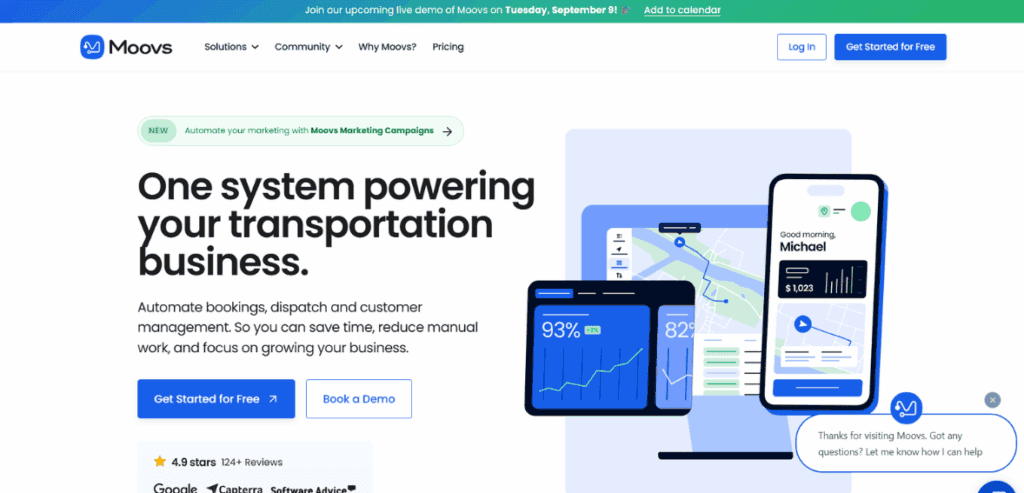
Image source
Moovs also offers branded passenger and driver apps, real-time vehicle tracking, automated dispatching, and robust analytics. In short, it’s a comprehensive, next-gen solution designed to streamline operations and enhance the customer experience.
Moovs is ideal for small to mid-sized limo and transportation companies that want a cutting-edge platform with all features under one roof. Because it includes extras like a customer web portal, live chat, and marketing CRM, it’s well-suited for operators looking to modernize and expand their business.
Companies that value a sleek user experience and proactive customer engagement (online bookings, automated follow-ups, review generation) will find Moovs particularly attractive. It supports various segments – from classic limo and black car services to party buses, shuttles, and even medical transport – making it a flexible choice for diversified fleets.
Pricing of Moovs
Moovs uses a flat-rate subscription model with no per-ride fees, which can simplify budgeting. Pricing starts at around $129 per month for the basic plan and about $179 per month for the pro plan with advanced features. All plans allow unlimited users, drivers, and vehicles. The higher-tier package adds capabilities like dynamic pricing, e-signature for contracts, and enhanced marketing tools.
There is no long-term contract required – operators can start with a free trial and then choose a monthly plan that fits their needs. The straightforward pricing (with a single monthly fee and no commission per trip) is a major selling point for Moovs, especially for growing businesses aiming to maximize usage without incurring extra charges.

Image source
Ground Alliance is a powerful enterprise-level limo dispatch and reservation system known for its extensive feature set and network capabilities. It stands out for providing a “global affiliate network” – a built-in platform to connect with affiliate limo companies worldwide for farm-in and farm-out work. This makes Ground Alliance especially attractive to operators who frequently conduct affiliate trip exchanges or corporate road shows across cities. Feature-wise, it has AI-driven dispatching, real-time fleet tracking, and branded mobile apps for passengers and chauffeurs.
Ground Alliance also excels in back-office automation, offering modules for accounting, automated invoicing, and corporate account management. Its system can manage complex pricing (hourly, point-to-point, packages) and integrates with industry tools like global distribution systems (GDS) and travel agencies. Essentially, Ground Alliance is a “one-stop” platform tailored for the limousine, black car, and shuttle industry, with an emphasis on scalability and integration. It often appeals to larger operators due to features like multi-company management, advanced analytics, and 24/7 support.
Ground Alliance is best suited for mid-sized and large limousine companies, or smaller companies that are rapidly scaling and need enterprise-grade capabilities. If your operation handles a high volume of trips, serves corporate clients, or frequently works with affiliates (e.g., farm-out trips to local partners or accepts farm-in jobs), Ground Alliance was built for that environment.
The platform’s support for international operations (multi-currency, multi-timezone) and its robust affiliate exchange mean global operators and those in networks will benefit greatly. It’s also ideal for businesses seeking cutting-edge technology, such as AI scheduling, or those requiring integration with external systems (flight trackers, expense management, etc.). Keep in mind that Ground Alliance’s rich features come with complexity – it may require more onboarding and training, but it pays off for companies needing its depth and flexibility.
Pricing of Ground Alliance
Ground Alliance offers tiered pricing plans based on monthly trip volume. For example, the entry-level “Plan 300” supports up to 300 rides per month at $99 per month (with a one-time setup fee of $299). Plans scale upward for higher volumes: e.g., $199/month for ~1500 trips, $399/month for 5000 trips, and so on, up to an Unlimited plan at $999/month that allows unlimited rides.
All plans include unlimited users, drivers, and vehicles, making them ideal for larger staffs. Notably, certain premium features are add-ons – for instance, the branded passenger mobile app is an optional module ($99/month extra), and integrations with systems like Deem or GroundSpan (popular for corporate travel bookings) incur additional fees per ride.
This à la carte approach lets operators pick and pay for what they need. Ground Alliance’s pricing model is flat monthly plus any chosen add-ons (no per-trip commission, though some integrations charge small per-booking fees). This can be cost-effective for high-volume businesses, but smaller operators will want to choose a plan appropriate to their volume to avoid “overbuying.”
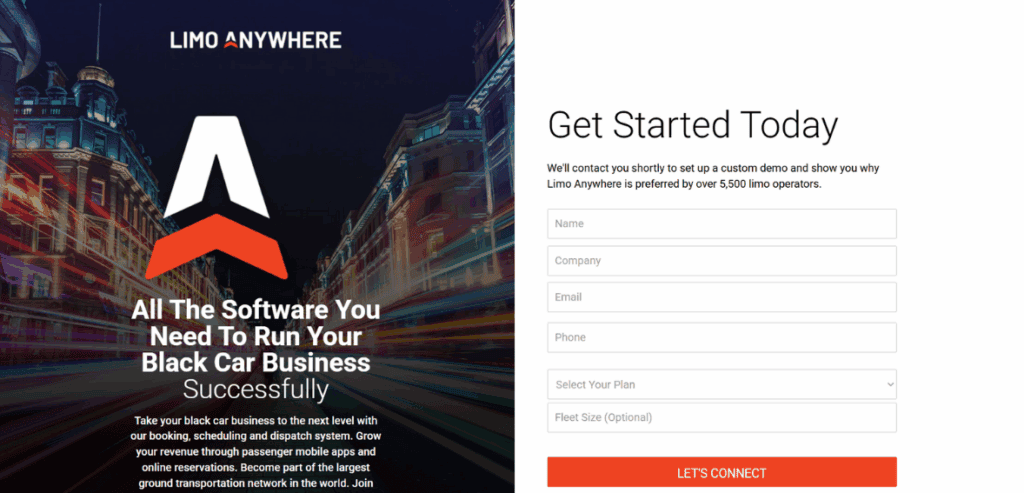
Image source
Limo Anywhere is one of the most established and widely used software platforms in the livery industry. Known for its reliability and comprehensive feature set, Limo Anywhere offers tools for desktop and mobile booking, dispatching, scheduling, billing, and more, all in one system.
It has a long track record (over 15 years in the market), so it’s very feature-rich and has benefited from continuous improvements. Strengths include a robust reservations and dispatch board, a solid driver mobile app (DriverAnywhere), and a customer-facing booking engine that many operators embed on their websites. Limo Anywhere also has an Affiliate Network feature, allowing you to send and receive jobs with other Limo Anywhere users easily, which is excellent for building a nationwide service network.
Over the years, Limo Anywhere has added modern touches like a passenger app, SMS notifications, and incident tracking. Still, its most significant appeal is dependability – it covers all the basics that a limo company needs in day-to-day operations. There is also a large community of operators who use it, meaning plenty of third-party integrations and support resources. In summary, Limo Anywhere’s strength lies in being a proven, all-round solution with the essential functions for dispatch, combined with newer enhancements like cloud hosting and mobile apps.
Limo Anywhere is a versatile platform suitable for operators of virtually any size, from owner-operator small fleets to extensive multi-city services. Its modular pricing plans (Starter, Standard, Pro, etc.) make it accessible to a small business on a budget. At the same time, its feature depth (with add-on modules for things like API integration or advanced reporting) can satisfy larger enterprises. If you’re looking for an industry-standard solution that many chauffeurs and dispatchers are already familiar with, Limo Anywhere is a safe choice.
It’s especially popular among traditional limo services, airport transportation companies, and those who value a stable system that thousands of users have tested. Companies that participate heavily in affiliate work also appreciate Limo Anywhere’s built-in affiliate connections and its widespread usage (making affiliate trip exchanges smoother when both sides use LA).
On the other hand, extremely tech-forward companies might find Limo Anywhere’s interface a bit dated compared to newer startups – but its reliability and broad functionality are hard to beat.
Pricing of Limo Anywhere
Limo Anywhere uses a tiered monthly subscription model based on the number of rides (reservations) you handle per month, with the flexibility to scale up as you grow. The Starter level begins around $99 per month (plus a one-time setup fee of $299) which covers a base volume of trips (e.g. up to a few hundred bookings).
As your volume increases, you’d move to higher plans – for instance, Standard, Pro, and Ultimate plans range roughly from a couple of hundred dollars up to around $800+ per month for high-volume fleets, and enterprise accounts (15,000+ trips) can go above $1,200 per month.
In addition to the core platform, certain features come as paid add-ons: e.g., the passenger-facing mobile app, SMS texting beyond a certain limit, or integrations to external systems might add costs. Limo Anywhere’s pricing also includes $0.25 per trip over your plan’s limit on some tiers, so the cost scales with usage. All plans allow unlimited users (dispatchers, drivers, etc.), which is a nice benefit.
LimoExpress is a newer entrant gaining traction, notable for its user-friendly design and global approach. This platform was built to address common pain points in the limo and private car industry: it streamlines manual booking processes, improves dispatcher-driver-client communication, and provides a smooth digital customer experience.
LimoExpress comes with a clean, modern interface for dispatchers and an easy-to-use driver app with real-time updates. It offers features like automated scheduling with Google Maps integration (for optimized routes and accurate drive times) and a public booking form you can embed on your website to capture online reservations.
One of LimoExpress’s strengths is comprehensive communication tools – it sends instant push notifications to drivers for new jobs or changes. It can automate emails/SMS to customers for confirmations and status updates. The platform also includes built-in CRM capabilities (passenger profiles, preferences, feedback collection) and detailed reporting dashboards.
Uniquely, LimoExpress is multilingual and multi-currency, reflecting its design for international use (the interface is available in over 10 languages). In summary, LimoExpress provides a scalable, cloud-based system that emphasizes ease of use and efficiency, making it a strong choice for operators looking to modernize outdated workflows.
LimoExpress is ideal for small to mid-sized limo and chauffeur companies, especially those that operate in international markets or serve a diverse client base. Its tiered user-based plans (teams of 5, 10, 25, 50 users) make it accessible for a small startup limo service and able to grow with you as you add more staff.
Because it’s a relatively new system with a fresh interface, it can be an excellent fit for companies that want to quickly get onto a modern platform without a substantial upfront investment. It’s also well-suited for companies that need multi-language support or that work with global travelers – for instance, operators in Europe or the Middle East can benefit from localized language options in the system.
Additionally, LimoExpress has features to support affiliate work: it integrates with the GNet affiliate network to allow farm-in and farm-out reservations with partners. This makes it a good choice for operators that rely on affiliate jobs but may not be able to afford the larger enterprise systems. In short, if you want a cost-effective, globally friendly dispatch solution that covers all the basics (and then some), LimoExpress is worth a look.
Pricing of LimoExpress
LimoExpress offers simple, user-based pricing tiers, and all feature modules are included in every plan (there are no hidden fees for adding certain features). The plans are structured by the number of user accounts (dispatchers or staff) needed: for example, Team 5 (up to 5 users) is €48 monthly, Team 10 is €95 monthly, Team 25 is €215 monthly, and Team 50 is €359 monthly.
These prices are flat rates (excluding taxes) and include unlimited rides, vehicles, and affiliates, which means even the lowest plan supports full operational capacity in terms of trip volume. LimoExpress also offers a 14-day free trial and claims “no hidden costs.” Notably, the pricing in Euros hints at their international focus. Still, the system can be used anywhere (the company is based in Europe but serves the U.S. and other regions as well).
There is an optional onboarding fee for personalized training/setup, but it’s not mandatory. Included in the subscription are the passenger web portal, mobile apps, and even a certain number of SMS and flight-check credits per month for free (higher plans include more of these).
This all-inclusive pricing can be beautiful – you know exactly what you’ll pay each month. If none of the predefined plans fit (say you need more than 50 users or have unique needs), LimoExpress will work on a custom plan. Overall, LimoExpress pricing is transparent and competitive, especially for smaller operators who get a full-featured system at a low monthly cost.
Yelowsoft is a versatile dispatch software platform that serves both the taxi and limo industry, with a strong emphasis on automation and a “white-label app” experience. In the context of limo operations, Yelowsoft’s dedicated Limo Dispatch Software solution recognizes key differences between chauffeured services and standard taxis – for instance, it supports reservations, hourly charters, and detailed client preferences, which are crucial for limo businesses.
Yelowsoft’s strengths include its real-time automation (auto-dispatch and live GPS tracking), and its fully branded passenger and driver apps that can carry your company’s logo and colors. The system comes with features like route optimization, flight tracking, and multi-stop itinerary support. Another strength is its broad integration capabilities: Yelowsoft can integrate with various third-party services (from mapping APIs to telephony and SMS gateways), making it very flexible. It also offers built-in marketing tools, including promo code management and referral programs.
Essentially, Yelowsoft offers a tech-forward platform, akin to an “Uber-like” system, that you can control to elevate a traditional limo business into a modern on-demand service, if desired. It’s also known for robust analytics and a clean dashboard that helps dispatchers monitor operations in real time.
Yelowsoft is ideal for limo operators who want a highly customizable and mobile-centric solution, possibly those who also have a mix of on-demand and scheduled rides. If you operate a limo or black car service and want to provide an app experience similar to ride-hailing services (with features like instant ride requests and driver ratings), Yelowsoft is a suitable solution. It’s also great for startups and growing companies because of its flexible pricing and cloud setup – you can start small on the Starter plan and upgrade as you gain more business.
Yelowsoft’s system is used worldwide, so it works well for companies outside the U.S. too (supports multiple languages and local integrations). Operators who are very passenger-experience focused (wanting slick mobile apps and automated notifications) will appreciate Yelowsoft. Additionally, those who need custom integrations or have unique workflows might favor Yelowsoft, since the company often touts its ability to tailor solutions (with custom modules or API integrations) for clients.
Keep in mind, if your operation is more classic limo-style (all pre-scheduled), Yelowsoft can handle it, though you might not use some of its on-demand features – but it’s nice to have the option as your business evolves.
Pricing of Yelowsoft
Yelowsoft offers several pricing tiers, generally aimed at ride-hailing startups and fleets, but these apply to limo operations as well. The plans are based on a monthly subscription plus a cap on the number of trips included (with modest per-trip fees for excess usage).
As of 2025, the Starter plan is $149/month and includes up to 500 trips (additional trips at $0.39 each). The Professional plan is $399/month for up to 1,500 visits (additional at $0.36 each), and the Growth plan is $1,149/month for up to 5,000 trips (additional at $0.30 each). There is also an Enterprise option for volumes beyond that, which is custom-priced.
Note that Yelowsoft charges a one-time setup fee ($999 for Starter, $1,499 for Professional, $1,999 for Growth) to cover deployment and branding of your apps. All plans come with the core features (admin panel, user/driver apps, live tracking, etc.) and unlimited users/drivers. The higher tiers give faster support response times and the ability to operate in more regions/languages simultaneously, which can be important for larger businesses.
Yelowsoft often runs on a contract (e.g., annual pricing saves ~20%), but the monthly figures above are available if you prefer flexibility. Overall, the pricing is on par with other premium platforms – a mid-sized limo operation might lean toward the Professional plan. It’s wise to calculate your average monthly trips to choose the most cost-effective tier. The good news is Yelowsoft’s plans scale so that you won’t be overpaying during slower months; you only pay more when your trip volume increases (via the per-ride overage fees).

Choosing the right limo dispatch and booking software is a crucial decision. To make an informed choice, it’s essential to go beyond marketing materials and ask the right questions during demos or trials. Below is a checklist of key considerations and questions that limo operators should use when evaluating any platform:
If you rely on a network of partners to fulfill rides, ask how the system facilitates affiliate bookings. Can it send and receive reservations with other companies’ systems? How are payments or commissions handled for farm-out trips?
(For example, some platforms have built-in affiliate networks or automated affiliate payment features, while others may require manual reconciliations. Ensure the software won’t create headaches in managing revenue splits with your affiliates.)
A modern limo platform should offer more than just booking by phone. Ask to see the passenger app (or online booking tool) in action. Can customers get instant price quotes, real-time ride tracking, and driver ETAs? Can they view and edit their bookings, and do they receive automated notifications (text or email) for confirmations, driver en route, etc.?
A strong passenger app will improve your client’s experience and reduce calls to dispatch. Make sure the app is branded for your company (white-label) and available on iOS/Android as needed.
Payments are a big part of your operations, so dig into this. Does the software have its built-in payment processor, or does it integrate with third-party gateways (like Stripe, Authorize.net, or Host Merchant Services)? If it’s built-in, what are the processing rates, and are there monthly minimum fees?
If it integrates externally, is the integration already developed and included, or will you need custom work? Also, ask how things like refunds, tips, and split payments are handled. The goal is to ensure that collecting fares and charging customers’ cards will be easy for you and frictionless for the client. Transparency on processing fees (transaction percentage, flat fees, chargeback fees, etc.) will help you avoid surprises on your bill.
Many limo businesses serve corporate clients who require monthly invoicing, specialized pricing, or credit terms. Confirm if the software supports corporate account profiles, the ability to bill rides to a central account (instead of an immediate credit card charge), and generating consolidated invoices for multiple rides.
Ask: Can it handle custom rate agreements, purchase order numbers, or employee reference codes? If you do a lot of B2B work or contract services (e.g., for airlines or hotels), the software should be flexible in billing and reporting to meet those clients’ requirements.
Since limo operations often involve pre-scheduled rides (sometimes booked weeks in advance) as well as on-demand requests, ensure the software excels at both. Ask if it can easily handle future reservations, recurring bookings, and last-minute changes. Does it have features like a visual dispatch grid or calendar, and automated dispatch for efficiency? Can dispatchers override and manually assign as needed?
The software should match the way your team works – whether that’s actively managing every trip or letting automation do the heavy lifting during peak times.
A great platform will include a robust driver app and communication channel. Ask to see the driver app: Does it provide drivers with all necessary trip details, navigation, and the ability to update statuses (on location, passenger onboard, etc.)? Is there an in-app chat or communication module for drivers to contact dispatch discreetly?
Also, inquire about driver management features like shift scheduling, hours tracking, or vehicle inspection reports if those are important to your ops. Efficient communication tools will keep your chauffeurs connected and accountable.
Data is key to improving your business. Ask what built-in reports the software offers (e.g., revenue reports, utilization rates, customer feedback, affiliate settlement reports). A sound system should provide you with insight into your top clients, most profitable routes, driver performance, and more. Is there a customizable reporting feature or at least export capabilities (CSV/PDF) so you can analyze data outside the system if needed?
Make sure the platform can deliver the metrics that matter to you – whether it’s financial stats, operational KPIs, or marketing information.
Finally, don’t forget to ask about the human element. When you sign up, will you have a dedicated onboarding specialist to help import your existing customer data and reservations? How much training is included for your staff and drivers, and in what format (live training, manuals, videos)? Also, check on support: Is customer support 24/7 and via what channels (phone, email, chat)?
Knowing the level of support (and whether it costs extra) is crucial, because software is only as good as the help you get when something isn’t working as expected. You want a provider that will be a partner in your success, not just a vendor.
In 2025, the limousine industry is no longer just about polished vehicles and professional chauffeurs; it’s about delivering a fast, frictionless, and tech-enhanced customer journey. Modern limo dispatch and booking software isn’t a luxury; it’s the backbone of a competitive operation. The right platform can be the difference between merely keeping up with industry changes and using them to your advantage.
From the all-in-one convenience of Moovs to the enterprise-grade network capabilities of Ground Alliance, the proven reliability of Limo Anywhere, the international friendliness of LimoExpress, and the on-demand flexibility of Yelowsoft, there’s a solution for every type of operator. The key is matching your business model, client expectations, and growth plans with the platform that aligns best with them.
By focusing on features that enhance both customer experience and internal efficiency, real-time tracking, automated communication, integrated payments, affiliate networking, and data-driven decision-making, you’ll position your business to thrive in an era where speed, transparency, and convenience define service excellence.
The takeaway is clear: adopting the right limo software isn’t just an operational upgrade, it’s a strategic move that can boost revenue, strengthen client loyalty, and future-proof your fleet against evolving market demands. In a world where Uber-like convenience is the norm, the limo companies that embrace modern technology will be the ones leading the road ahead.
Limo dispatch software is a specialized solution designed to automate reservation management, driver dispatch, vehicle tracking, billing, and customer communication. Unlike generic taxi systems, it supports advanced bookings, chauffeur protocols, and luxury service expectations.
Automation ensures optimal ride assignments based on availability, proximity, and vehicle type, while GPS tracking enables route optimization, reduces wait times, and elevates efficiency and customer satisfaction.
Yes, most modern platforms provide tools for scheduling in advance (including recurring or multi-leg trips) while also managing urgent ride requests using features like availability calendars and priority dispatching.
Absolutely. Many providers offer flexible plans tailored to varying sizes—small teams can begin with more affordable, entry-level tiers, with the option to scale up as needed.
Unlike generic platforms built for reactive, metered services, limo software is designed for high-end, pre-scheduled operations. It enables features like client preferences, chauffeur matching, hourly or package pricing, and personalized workflows that preserve the luxury brand experience.